

Summer Scrapbook
Notes from fields, gardens and waterways during a summer of heatwaves

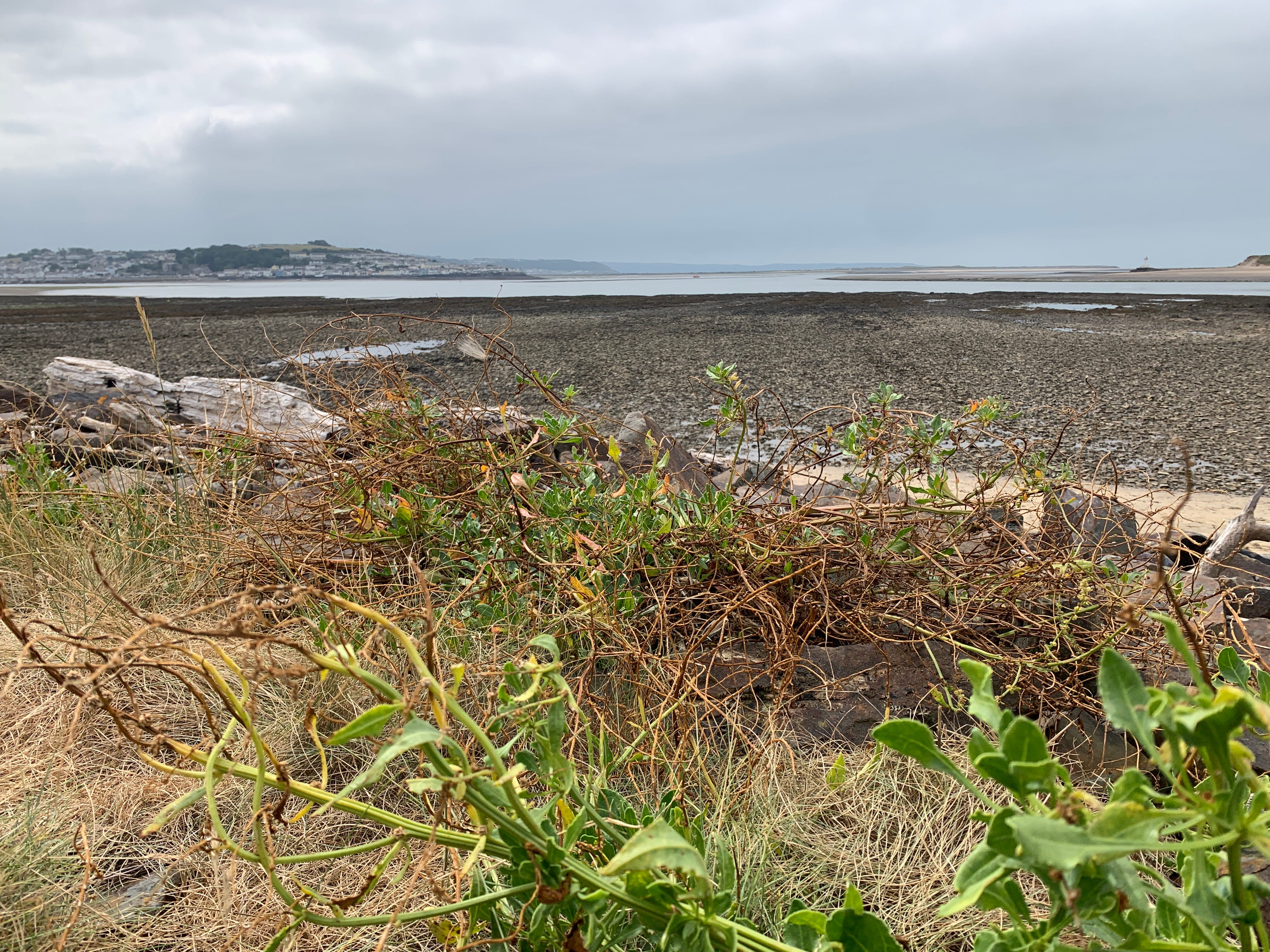
Hello
How’s your summer going? As mine began someone said to me, I hope the summer is full of many unexpected gifts and adventures for you.
I was sceptical, but, along with some less than shiny moments, it has been.
Perhaps this is what life is.
As we nudge towards autumn and new beginnings, this post is part newsletter, part field note. It ambles around my garden, up to Somerset and across to Appledore, and closes with some (for me) huge writing news. It’s on the long side so I hope it finds you on a beach or in a hammock, or somewhere you can grab a cup of tea and hunker down or treat it like a scrapbook and just skip the bits that don’t appeal.
Thanks, as ever, for reading along with me. I love having you here.
Ysella x
July heat
In July we were in the middle of the second of four heatwaves of the summer. Most mornings I could sit out with my breakfast, listening to wasps eating the woody stems of last year’s cow parsley, watching the blackbirds ferreting for grubs behind the everlasting sweet peas, in the weed-scrambled bits of border. The heat meant that for the first time I was able to grow tomatoes to ripeness outside, but it also meant that the front page of the local paper carried images of farmer’s fields on fire, while in Spain, Greece and Portugal, wildfires raged.


As I ate my breakfast I listened to the squeak of the second brood of baby blackbirds in their tidy nest in the shed. Below in the courtyard the swallows were hatching their second brood too. The first fledglings played and dived mischievously around the house and garden, coming in through the open windows and skimming past so close I could feel the beat of their wings.
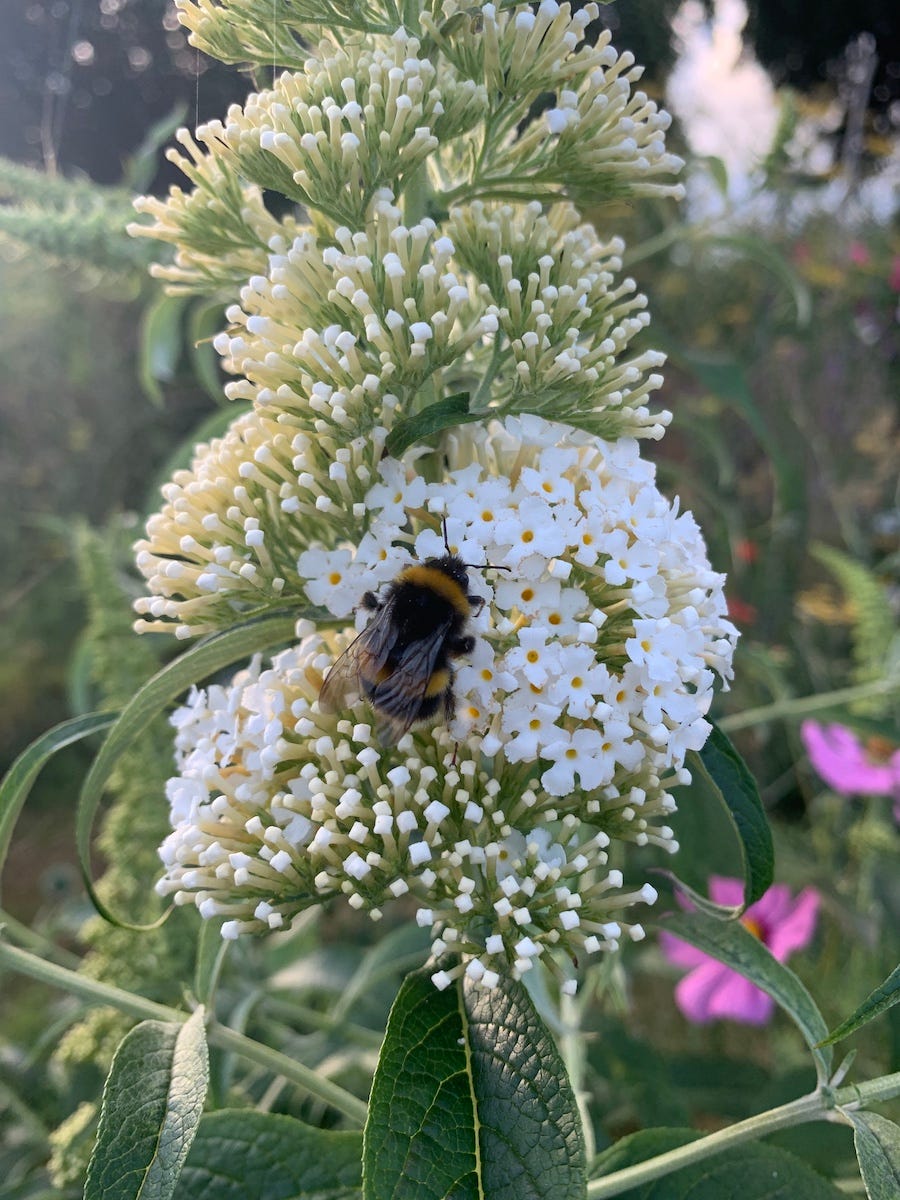
The garden was full of flowers and flight - the borders vibrant with colour - the yellow of golden rod, purple of corncockle, the hot and soft pink of everlasting sweetpeas, the scarlet of self-seeded poppies. Butterflies - tortoiseshells, admirals, peacocks, skippers, large and small whites, small browns, tortoiseshells - skipped over the cosmos and buddleia and bees buried themselves, like face-planted drunks in the flowers.
Pigeons crashed about in the copper beech, a pair of ringneck doves cooed over each other on the chimney, a wren chitted from the apple tree. Buzzards wheeled overhead among the black semaphore of swallows and screeching swifts. In the orchard chickens scratched at the dry ground looking for slow worms, making the treadle clunk, raising an alarm call when the sparrowhawk hurtled through to pick a sparrow out of the mulberry tree.
August fields
In August I visited family in Somerset and we walked across familiar fields with the now ageing dogs, the sun hot on our backs like we were at the beach. The fields were tinder dry and bleached and as we walked, seeds snapped, crackled and popped. There were little pools of colour in the gold and white - wildflowers - white convolvulus, yellow hawksbit - bees on their furry faces - and pink cabbage flowers. Mum looked girl-like and beautiful as she bent to look at them.
‘I’ve never seen the grasses without seeds on,’ she says, ‘everything’s fruited and flowered so early this year’.


Across the country councils were issuing warnings not to sit under trees shedding their boughs from stress, while acorns, apples and blackberries were already littering pavements and parks. The conkers were nearly ready, the tops of the hedgerows crimson and purple with elderberries and hawthorn. Through into the wood we found that the moss was dry on the trees and rocks, that even the hardy dog’s mercury was wilting. But back out into another field and there’s the smell of hot earth, of dried grass, a view of green hills dried to yellow, a Georgian farmhouse, corrugated roofed farm buildings, a Victorian church on the horizon, and a sense of timelessness.
Back in the garden
Back home in my garden the scratchy lawn is a shimmer of new white wings; the ants are flying. The grass stalks vibrate with tiny legs as the ants climb to take off like so many drones going to tackle an unseen foe. Coop lies curled in the cool and I listen to the sound of crickets, the comforting squeak of the iron gate on the footpath beyond the hedge. As the light fades the bats begin to swoop and Coop wanders off to bother the hedgehog that he knows will be under the bird feeder. I call him back crossly and he pretends not to hear.
Out walking, I meet a friend and neighbour and our conversation ends up at a familiar place - catastrophising about the impending apocalypse.
‘Well’, she says, ‘if it is the end of the world then I can’t think of anywhere better to be than your garden.’
I hug her, grateful for the reminder to be here now.
Appledore
We go to stay at my dad and stepmum’s house in Appledore for a few days while they’re away. Their house sits on top of Pitt Hill and commands what I think is the best view of the village and Torridge estuary. From the front window you can see Appledore’s colourful streets, the white stretch of Instow over the water, Tapeley Park up on the hill, the dockyard at its foot. I watch the world go by, feeling a part of it without having to be, watching the light chasing across the water, the weather rolling in and out, the holiday traffic winding through narrow streets. At night the bay lights up with a hundred white lights and the occasional blue of flashing emergency vehicles on each side of the water - people’s lives unfolding and folding.


On the banks of the estuary we find abandoned relics, reminders of its industrial past; graffitied ships and ropes, abandoned buoys, and walkways that lead nowhere. I watch a small flock of dunlin dip and slide along the watermark, watch the tide eddy around the rusty and flaking dock, a fluff of white foam circling it, a gull pronouncing ownership.
Quayside
Down at the quay at 7pm the pavements are still warm and there’s a holiday glow on the water. The tide is back in, making sense of the geography and covering the wiggly curve of the inlet across the sandbank. The estuary no longer resembles a basin with the plug pulled, stranding a curious debris of boats and buoys. Flotillas of calm-white sailing boats drift and ebb at its edges.
A throng of holidaymakers, locals and supporters (from as far away as Barnstaple!) for the gig teams competing in the regatta, line the quayside. Kids dangle crab lines off the side of its high walls, filling clear-sided buckets with clawing crabs.
‘Not like that!’ says a dad to his over-enthusiastic son, wrapping his slight weight over the railings to pull on a line. Two women guard their positions from camping stools while pink-necked holidaymakers eat fish and chips from boxes on benches, lids raised against the circling gulls. A group of boys, their skin bumpy with cold, jump the steep drop into the water, joining the clamour of kids on the steps climbing out to go again. There’s the smell of hot food; garlic, chips, barbeque, while outside the Seagate drinkers watch with pints in their hands.
The gig races are short but dramatic. Teams compete in a rhythmic pull as coxes shout them on. Cheers and shouts go up from the quayside and a deafening horn blasts as the first gig crosses the finish line. The winning team raise their oars to the sky. On the pavement a marshal walks the line announcing the next race and calls for contenders to prepare. There’s a sense of excitement and tension, camaraderie and competition.
At the slipway the gigs concertina, waiting their turn to come ashore - a new dance, a new rhythm. Rowers stand in the water or walk the length of boats congratulating and consoling each other with easy confidence.
I can’t help but think of the small boat crossings, of the contrast with people navigating journeys of a different kind - crammed in dinghies, vulnerable and exhausted; afraid, uncertain. People landing on unfamiliar shores amongst strangers - a different land and language.
But one of the chief pleasures of being away is being around others on holiday - of remembering that it’s August and summer and that these are the good times, the easy times, the rest times. Back at the house from the garden we hear the sounds of families talking over plans for trips and meals, kids playing and arguing, showers running, dogs barking.
The Champ
After a trip to the Champ, a community pub where we’ve eaten fish and chips from next door, drunk the local ales, thumped along to the folk club tunes and made friends of everyone and their dogs, we walk home happy through the lanes. We look into windows and see people on sofas and phones, walk along the quay watching the lights on the water, climb up the streets through clusters of crowded houses until we are in a wild alley between the houses and fields earmarked for development. The path is dark and prickly and smells of honeysuckle.
Suddenly there is something small, dense and angry barrelling towards us, crashing through the undergrowth.
‘What the hell is that?!’ I exclaim.
‘A badger’, says Glen, without alarm.
Coop appears, wagging his tail. Maybe we have disturbed the badger from feasting on greengages and apples beneath the trees in the little playing field near to the house. I wonder what will happen to him - to all the wildlife inhabiting the fields over the brambly hedge - when the bulldozers move in.
Everything is on the move, borders, people, wildlife.
We sit on the bench in the playing field and look across the water, the air still warm. Suddenly a rush of flight fills the dark sky - terrifying, vast, noisy - a nebulous white cloud of screeching and movement. I can’t tell how big it is, where it is heading, or whether it will overwhelm us. As quickly as it appears it turns, quietens and fades and my heart begins to quiet with it.
Perhaps this too, is how life is.
Writing news


Regular readers will know that a year ago, I decided to take a punt, a dive off the side of my life to find a more creative path. The year has been what everyone says freelancing is - a rollercoaster.
During the summer, while I wrangled with angst about what might come next, a wise friend said to me, ‘We think that life and careers should build like a line on a graph, but that’s not realistic. Instead they dip, grow, and flatline. All of life is an apprenticeship. We can pick things up, try them on and put them down if they don’t fit. It doesn’t have to be fixed.’
With paid work a little thin on the ground I began working on the stories I wanted to tell to keep the swirling panic at bay. One of them, the story of my great grandfather Sandosham, who set off on a journey of wit and ambition from Tamil Nadu in 1897, is one I’ve been trying to tell for decades. I applied to Arts Council England for their Develop Your Creative Practice fund to help me develop it further.
But as summer rolled on and reality began to bite, I began to apply for jobs too, which means that I’m about to return to the relative safety of PAYE employment. It’s a job that’s meaningful and for a cause I believe in, so I feel very fortunate.
And then a few weeks ago came the news that my DYCP application had been successful. I’m still pinching myself.
At the start of my freelance adventure a kind friend sent me a postcard that’s been on the wall next to my desk ever since. On it she wrote this, from Julia Cameron: One of the things most worth noting in a creative recovery is our reluctance to take seriously the possibility that the universe might be cooperating with our new and extended plans.
Having both the stability of a job and funding to give me space to write feels like a big yes from the universe.
What the funding means is that I can develop my first longform creative nonfiction book. The Edge of the Village: Displacement, belonging and the land we leave behind will be a blend of memoir, cultural history and ecological reflection, centring on Sandosham’s story. I get to work with two mentors whose work I admire - writers Elizabeth Wainwright and Davina Quinlivan - and travel to India to research my family’s connection to the place Sandosham left behind.
And then the news that this essay, Shifting Sands, the genesis of my project, was to be published by Little Toller Books in The Clearing. I can’t tell you how long I have dreamed of contributing to this journal.
You can read the essay in The Clearing (and check out all the other fabulous work) here.
So I’m saying thank you to the gods of creativity and bloody-mindedness, while also feeling a teensy bit daunted. As the project develops I’ll be sharing news about it here, so I hope you’ll come along with me for the ride.
I’m so grateful to everybody who’s got in touch to wish me well after sharing the news online and in person - it’s the kind of support and vote of confidence that will make the difference over the coming months, especially when the imposter syndrome bites.
Wishing you a fruitful and peaceful autumn, wherever you are.
Ysella x
So pleased for you Ysella! the DYCP is ridiculously hard to get. Such a worthwhile project and can't wait to read the results. Good luck with it! Closer to home, I'm also liking the garden ramblings too :)
Ysella, thank you again for allowing me to sit beside you and share your visions. You are so very inspirational. Congratulations on receiving your funding that will allow you to expand. Sending my best to you and Glenn and a big Pat to Coop